


FGT 35.30
The power of a laser is P=0.4mW. This is the rms power.
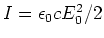
The intensity is related to the power by,
I = P/Area.
The intensity is related to the peak electric field by
 ,
and the peak magnetic field
is related to the peak electric field by,
B0 = E0/c.
When the laser is focused on a spot of diameter d = 1.2mm,
we then find,
E0 = 516N/C,
,
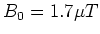
and the peak magnetic field
is related to the peak electric field by,
B0 = E0/c.
When the laser is focused on a spot of diameter d = 1.2mm,
we then find,
E0 = 516N/C,
 .
However
when the laser is focused on a spot of diameter d=633nm,
the peak electric and magnetic fields are,
.
However
when the laser is focused on a spot of diameter d=633nm,
the peak electric and magnetic fields are,
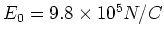 ,
B0 = 3.25mT.
,
B0 = 3.25mT.
FGT 35.39
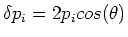
The momentum transfer when a particle of
momentum pi reflects elastically
at angle  (to the normal)
from a surface, is given by,
(to the normal)
from a surface, is given by,
 .
The momentum flux (= radiation pressure) is
then,
.
The momentum flux (= radiation pressure) is
then,
 .
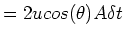
We are asked for the momentum
transfer, so we must multiply by the area over which
the pressure acts and the time over which it acts,
so that, momentum transfer
.
We are asked for the momentum
transfer, so we must multiply by the area over which
the pressure acts and the time over which it acts,
so that, momentum transfer
 .
.
FGT 35.52
A polarizer consists of conducting wires. Light of polarization
parallel to the direction of the conducting wires is
absorbed. Light perpendicular to the conducting wires
is transmitted. The polarization axis of the transmitted light is then
perpendicular to the direction of the wires.
The axis of a polarizer is then defined to
be perpendicular to the conducting wires so that light
which is polarized parallel to the polarizer axis is transmitted.
With this definition,
we find that,
| I2 = I0 cos2(47)cos2(63) = 0.096 | (1) |
FGT 35.64
In the summary to the chapter the formula
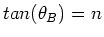 is given. This formula applies to the case of light
incident through air and reflecting off a material
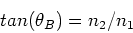
with refractive index n. The general formula is,
is given. This formula applies to the case of light
incident through air and reflecting off a material
with refractive index n. The general formula is,
 |
(2) |
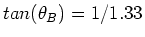 from which we find,
 .
.
FGT 35.65
The amount of energy absorbed is given by,
| E = 800*0.4*0.5*3600 J = 0.576 MJ | (3) |
| n = E/L = 14.1 moles | (4) |
FGT 36.26
Because the screen is so far from the prism, the majority of the distance between the blue and red spots is determined by the angles the two colors make when exiting the prism. We thus find these angles.
We find the outgoing angle  from using Snell's law at the
first surface,
from using Snell's law at the
first surface,
![\begin{displaymath}\theta_1 = 90-65, \ \ \ \theta_2 = sin^{-1}[{n_1\over n_2}sin(\theta_1)]
\end{displaymath}](img13.gif) |
(5) |
![\begin{displaymath}\theta_3 = 50-\theta_2\ \ \ \theta_4 = sin^{-1}[{n_2\over n_1}sin(\theta_3)]
\end{displaymath}](img14.gif) |
(6) |
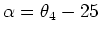
Plugging the numbers for blue light, with nb=1.528 yields,
 ,
,
 ,
,
 ,
while for red light, with
nr = 1.514 we find,
,
while for red light, with
nr = 1.514 we find,
 ,
,
 ,
,
 .
.
The location of the beams on a screen which is distance D=10m
from the prism is found from
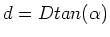 .
Plugging the
numbers for blue light gives
db=6.631m, while
for red light we find,
dr = 6.334m. The distance
between the two spots on the screen is then
.
Plugging the
numbers for blue light gives
db=6.631m, while
for red light we find,
dr = 6.334m. The distance
between the two spots on the screen is then
 .
.
FGT 36.27
In this problem we have to take account of the displacement
of the beam inside the prism as well as outside, because the
screen is close to the prism. Consider a co-ordinate system
centered at the apex of the prism, with the x-axis
bisecting the prism and the y-axis upward. The x distance
a beam travels inside the prism is given by,
x(y) = 0.866(1-y/1.5)where all distances are in cm. We use Snell's law at the
first surface, where
 ,
and so,
,
and so,
![\begin{displaymath}\theta_2 = sin^{-1}[{1\over 1.5}sin(30)] = 19.47^o
\end{displaymath}](img25.gif) |
(7) |
 .
Using
Snell's law at the second surface yields,
.
Using
Snell's law at the second surface yields,
![\begin{displaymath}\theta_4=sin^{-1}[1.5 sin(10.53)] = 15.91^o
\end{displaymath}](img27.gif) |
(8) |
| d1 = 2cm*tan(15.91)= 0.57cm | (9) |
| d2 = 0.866*tan(10.53) + 2cm*tan(15.91) = 0.73cm | (10) |
FGT 36.51
Rays which undergo total internal reflection at the water/air
interface cannot be seen by an observer above the water.
The condition for total internal reflection at the
water/air interface is,
![\begin{displaymath}\theta_c = sin^{-1}[{1\over n_w}] = 48.75^o
\end{displaymath}](img28.gif) |
(11) |
 (to the normal)
to the water/air surface. If
(to the normal)
to the water/air surface. If
 ,
total
internal reflection occurs. The longest rod
which is obscured thus leads to a ray at angle
,
total
internal reflection occurs. The longest rod
which is obscured thus leads to a ray at angle  from
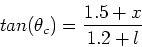
its tip. The geometry of the situation implies that,
from
its tip. The geometry of the situation implies that,
 |
(12) |
 .
Solving for l yields,
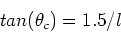
.
Solving for l yields,
 |
(13) |
 |
(14) |
FGT 36.52
The incident and outgoing rays are at angle 30o to the
normal to the surfaces of the slab. However inside the
slap the ray is at angle  to the normal.
is found from Snell's law,
to the normal.
is found from Snell's law,
 |
(15) |
 .
The vertical displacement between the
point of entry of the ray and the point
of exit of the ray is,
.
The vertical displacement between the
point of entry of the ray and the point
of exit of the ray is,
 ,
where t=2cm is the thickness of the slab.
If the ray had not been refracted, the exit point would have
been displaced vertically by,
y2 = 2.0tan(30) = 1.155cm.
The difference in vertical displacement is then
y = y2-y1 = 0.459cm.
The perpendicular distance between the two outgoing rays is
then,
d=0.459cos(30) = 0.397cm.
,
where t=2cm is the thickness of the slab.
If the ray had not been refracted, the exit point would have
been displaced vertically by,
y2 = 2.0tan(30) = 1.155cm.
The difference in vertical displacement is then
y = y2-y1 = 0.459cm.
The perpendicular distance between the two outgoing rays is
then,
d=0.459cos(30) = 0.397cm.